AI-This Time it's different. Again!
And now I have receipts.

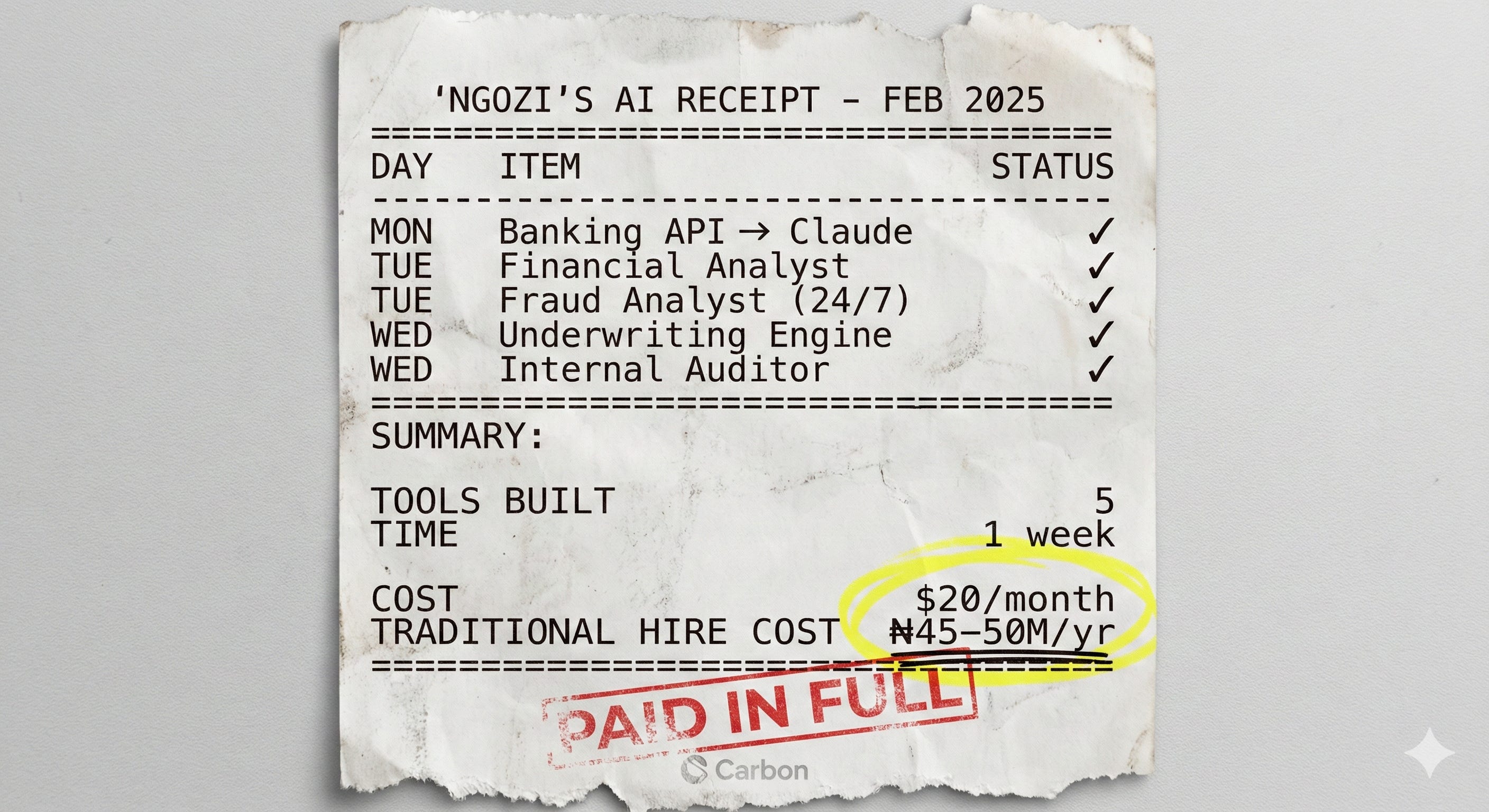
Looking at my drafts folder, I see a graveyard of articles that never made it. “Joy is the Mother of all Emotions.” “The God of Small Things.” I told myself the ideas weren’t fully baked. But really, I just knew none of them were going to be the one.
In 2023, I wrote “AI. This Time It’s Different” expecting to reach worldwide fame—at least amongst tech bros in Nigeria. Rather than being hailed as a modern-day thinker, the biggest response was someone asking if their subscription was really worth it.So imagine my annoyance when I see articles like Matt Shumer’s "Something Big Is Happening" causes a global sensation. If only you people had breathlessly forwarded my article to your WhatsApp groups or called all-hands meetings shouting that the end of the world was coming, I might have gone viral. I thought we were friends. You let me down.
But I’m not bitter. Because now I have receipts.
My Week
I haven’t slept properly in days. Not from anxiety—from excitement. I haven’t felt this way since 2008, when Chijioke and I started this journey and anything felt possible.
Here’s what I built this week:
Monday: Connected Carbon’s banking application to Claude. I can now operate bank accounts from anything that has a connected text box—Claude, Telegram, anything.
Tuesday (morning): Built a financial analyst that calculates unit economics for all Carbon loans across different time periods.
Tuesday (afternoon): Built a fraud analyst that reads incoming emails, verifies customers against our database, and freezes suspicious accounts. It works 24/7. Doesn’t take breaks. Doesn’t ask for a raise.
Wednesday (morning): Built a lending underwriting engine. Feed it 100 pages of bank statement, credit reports, KYC documents. Ten minutes later: decision ready.
Wednesday (afternoon): Built an internal auditor that reviews expenses in our Google Drive folder, traces them back to our expense portal, and validates our accounting entries in QuickBooks.
Five tools. Three days.
Total cost: $20/month. For all of them. Combined.
There is a Carbon engineer currently screaming “THEY ARE NOT PRODUCTION-READY”. Let’s agree to disagree abeg.
The Level Playing Field
I’ve been trying to recruit a financial analyst for six months—one that wouldn’t require me to sacrifice my unborn child on salary. I’ve searched for a product manager who could translate my ideas into the language engineers speak. I’ve hunted for an operations analyst who treats reconciliation as religion, not a nice-to-have.
Couldn’t find them. Couldn’t afford them. Couldn’t compete with the companies that could.
Now I have all three. And they cost me less than my weekly coffee bill.
Andela’s old maxim was “Talent is evenly distributed, but opportunity is not.” That was true. Past tense. If you’re an African founder, the playing field just got leveled. You couldn’t get that amazing fundraise. You couldn’t hire the dream team. You couldn’t compete with companies that had 10x your resources.
Now? Now you can build what they have. Not a perfect version—but a version. And a version beats nothing every single time.
Why Nigeria Has a Hunger Advantage
Here’s my most controversial take: Nigeria’s desperation is actually an advantage.
Remember Covid? The government announced lockdown. Everyone was supposed to stay home for safety. You know what happened? People were out the next day hustling. Okada riders were operating. Market women were selling. Construction workers showed up.
Why? Because the danger of dying from hunger was more immediate than the danger of dying from Covid. When you’re hungry, you can’t afford to be precious about theoretical risks.
The West is currently having a very nice, very privileged debate about AI safety, algorithmic bias, job displacement, and whether we should pause development to “consider the implications.”
Nigeria doesn’t have that luxury.
We can’t afford to pause and consider. We can’t afford to wait for perfect regulations. We can’t afford to worry about whether AI might make some jobs obsolete—because those jobs don’t exist here in the first place.
The West is focused on protecting what they have. We’re focused on building what we never had.
These are very different motivations. And right now, ours is the advantage.
The Demographic Arbitrage
There’s always been a correlation between population and GDP—assuming a functioning economy. This is why the West is panicking about fertility rates. Japan now produces more diapers for incontinent adults than for babies. Let that satisfying image sink in.
As the West ages, they’re also cutting jobs. S&P 500 vacancies are down 30% in the last year. UK graduate roles are down 33% from last summer. These aren’t future projections—this is happening right now, before AI has even fully arrived.
Jobs are disappearing in countries with no young people. People are exploding in countries with no jobs.
Meanwhile, Nigeria did not make the 2026 World Cup (don’t remind me), but I can promise you one thing: Nigerian men will be busy. So busy that by 2050, one in every seven people on Earth will be Nigerian. Our fertility rate isn’t declining. The demographic bomb is getting bigger.
This is either the greatest arbitrage opportunity or the greatest humanitarian disaster of our generation. There is no middle ground.
Here’s the irony: by the time AI fully explodes and eats those remaining Western jobs, the people best positioned to exploit it won’t be old-age pensioners clutching their adult diapers. It will be the generation of my children. Young people. Hungry people. People who don’t have legacy systems to protect.
In other words: us.
Nigeria’s Unfair Advantage
“Ngozi, have you lost your mind? Nigeria can barely keep the lights on and you’re talking about AI advantage?”
Hear me out.
The West spent 50 years building telecommunications infrastructure, banking systems, and regulatory frameworks. All of it designed for a pre-AI world. Now they have to defend it while simultaneously trying to innovate. It’s like renovating a house while people are still living in it—messy, expensive, slow.
Nigeria? We never built the house.
We have no entrenched tech companies blocking AI innovation to protect their turf. We have no complex regulatory frameworks designed to protect yesterday’s winners. We don’t give a shit about most regulations because we don’t have the institutional capacity to enforce them anyway.
AI won’t compete with our infrastructure. AI will BE our infrastructure.
The Honest Caveat
Let me be clear about what AI can’t do—yet.
It can’t replace foundational skills. Logic. Critical thinking. Domain expertise. The ability to know when the AI is confidently bullshitting you (and it will). You still need humans who understand the business deeply enough to direct these tools and catch their mistakes.
That Carbon engineer screaming about production-readiness? In all honesty, she’s right. These tools need supervision. They need guardrails. They need people who know what good looks like.
This is exactly why we are starting Japa School. Not to teach people AI tools—those change every six months. But to teach the foundational skills that make AI useful: critical thinking, clear communication, logical reasoning. The stuff our education system should have taught but didn’t.
Because here’s the truth: 10 million Nigerians with AI access but no foundational skills will just produce 10 million more convincing Yahoo letters. 10 million Nigerians who can actually think, then given AI? That’s a different story entirely.
The question isn’t whether you need training. You do. The question is whether you’ll get trained to exploit AI or get replaced by those who did.
The Call
If you’re a founder reading this and you haven’t spent serious time building with AI in the last month, you’re already behind.
I don’t mean reading about AI.
I don’t mean talking about AI at conferences.
I don’t mean adding “.ai” to your company name.
I mean building. Shipping. Breaking things. Figuring out what these tools can actually do for your specific business.
Start this week. Not next quarter. This week.
There are so many options out there but my preference is Claude Desktop.
Pick one painful, manual, time-consuming process in your business. Something you’ve been meaning to fix but never had the resources. Something you are completely convinced the tool cannot solve. Just throw it all in and see what happens.
You’ll be shocked at what’s possible.
And if you’re not a founder—if you’re a young Nigerian wondering how to position yourself for this shift—the answer is the same: build skills that make AI useful.
This is why Japa School exists. We’re not teaching people which buttons to click in ChatGPT. We’re teaching critical thinking, communication, problem-solving—the foundational skills that turn AI from a toy into a weapon. The skills that let you compete globally, whether you stay in Lagos or japa to London.
We’re aiming to train the next generation now because this window won’t stay open forever.
I built five tools in a week and it’s still only Thursday morning. They’re not perfect but they are adding value and last week they didn’t exist.
The question isn’t whether AI will change your business. It will.
The question is whether you’ll be the one building the future or watching it happen to you.
I know which side I’m on.
Interesting read! Indeed gaining AI can’t replace foundational skills. Logic. Critical thinking. Domain expertise. Gaining and sharpening these skills will be very valuable.
I sure don’t want to be left behind clutching the straws of yesterday. How can I join Japa school?