Software Developers Are Eating Themselves
We are next. And that's OK.

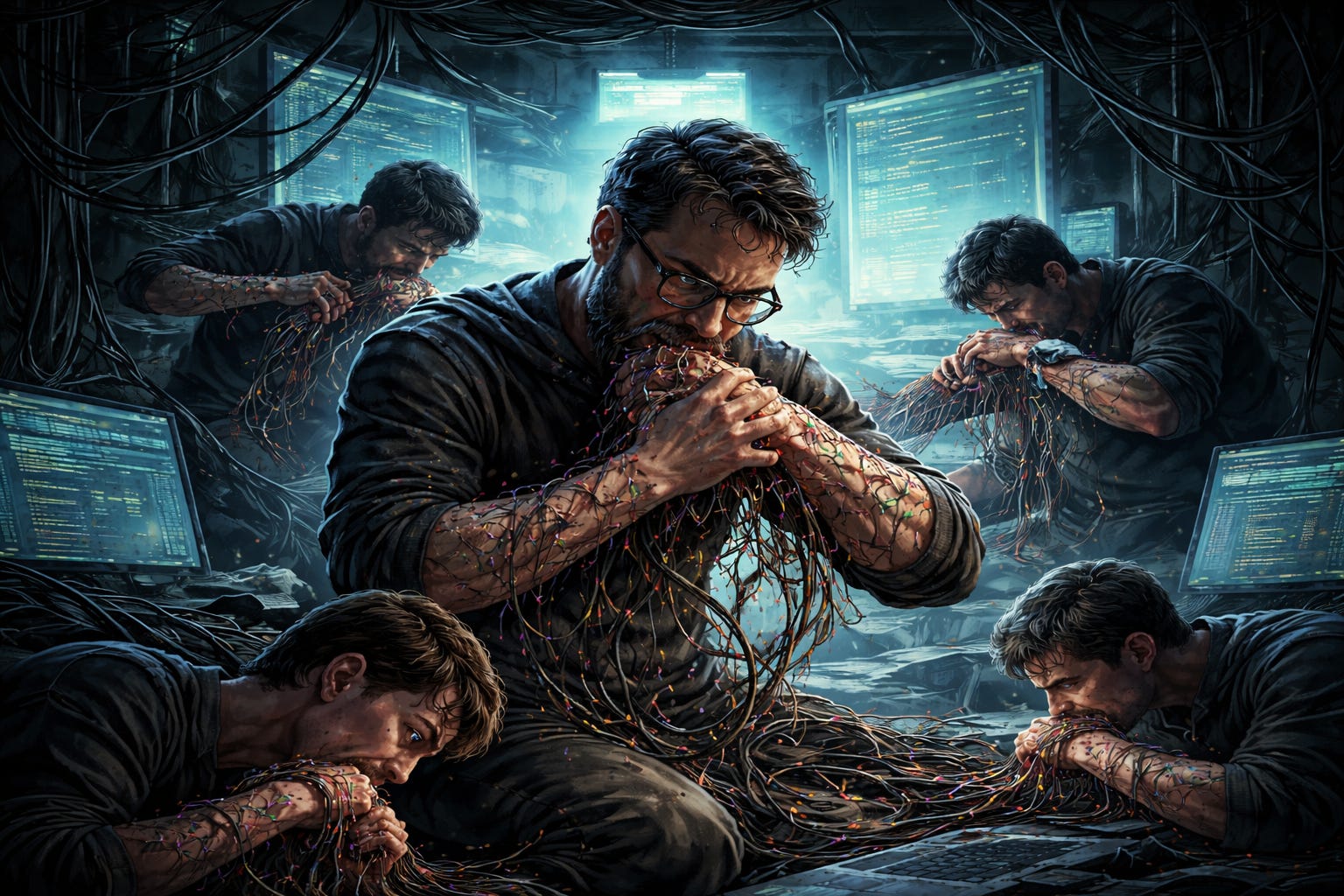
Today, we get to pick on the engineers.
In 2020, it was a heady time to be a software developer. Crypto was booming, Silicon Valley was giving money to everyone but me, and when Covid hit, work-from-home meant that a Nigerian developer didn't need a visa to fulfil their dreams of working in San Francisco or London. The great arbitrage was taking place. You could work as a developer for a Western company, get paid in crypto for five times your current salary, and your employer was happy because they still paid you significantly less than their local engineers.
An amazing time to be a developer. A terrible time to be a hirer of developers — in naira — as a company.
Everyone was happy except the Nigerian founder. Especially the non-technical Nigerian founder. Me.
There was already this sense that engineers were the most important function. They got paid the most, got the best laptops, and were not subject to the same rules as other employees. Everyone else would complain, but all you could respond was that software was eating the world and engineers spoke a language nobody else understood.
Founder: Why can't we send money on the app?
Engineer: We've got a race condition between the payout service and the ledger sync. A few webhook retries are idempotent, but others aren't, so we're throttling commits until reconciliation stabilises.
Founder: Erm, yeah. That makes sense — thanks for the feedback.
Now there was fear every day, with the implicit threat that people could leave at any point. Imagine thinking every day that Messi was going to leave or ask you for five times his salary. And that the team were in a queue behind him, listening.
During Covid, you didn't know whether those working from home were spending their time coding for your app, coding for somebody else's app, or interviewing. You'd hear rumours of people taking multiple jobs, and you'd ignore it, just praying that this side gig they were doing for you was something they actually cared about.
To try and help our staff, we gave everybody unlimited access to Udemy, so that whilst at home they could also learn new skills. I remember receiving the weekly report and seeing that one of our lead engineers was really putting in the hours on the platform. What was he learning, I wondered? Finance for dummies? Public speaking? The ancient art of haiku?
How to ace technical interviews.
Carbon lost about 70% of our engineering team in 2020. There are founders probably still undergoing therapy from that period, and if I'm honest, there's a part of me that is still scarred. But we survived and were content to bask in their shadow. In essence, we collectively raised them to God-like status.
And then they began to eat themselves.
AI came around in 2023, and the Ronaldos and Messis of the engineering world created something so good, so brilliant, that it began to make their role obsolete. Many engineers had taken delight in their exalted status, a level of 10x execution that nobody would ever reach. And perhaps they were right — because these Ronaldos and Messis created products in Codex, Gemini, and my second wife Claude Code that may have written themselves out of a job.
Over the last few months, story after story in the press: hiring freezes in engineering departments, companies laying off developers because of AI. If you put a gun to my head, I may confess to some schadenfreude while reading these articles. I can be vindictive, and as Oscar Wilde once said — whenever a friend of mine succeeds, a little part of me dies. I've since found Jesus, though, so I'm okay now.
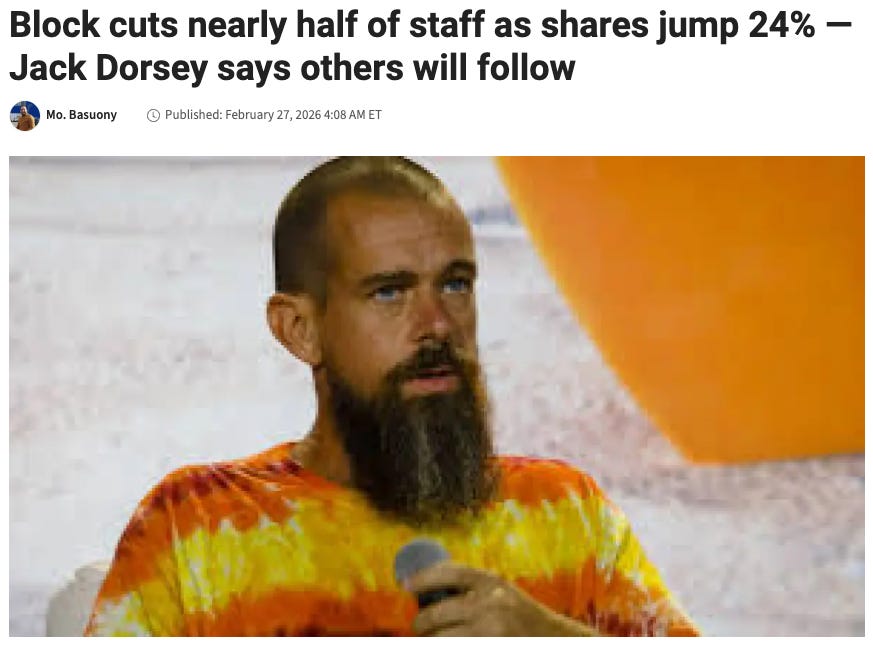
But Jack Dorsey announcing that Block is letting go of 4,000 of its 10,000 employees because of improvements in AI stopped me dead in my tracks. The dam has broken.
Am I laughing? Hell no, because I am next.
Those of us so-called knowledge workers have wielded glitzy PowerPoints and heavy financial models to convince investors and others that our degrees gave us God-like status. We are just a few steps away from the developers.
I have been working feverishly these past few months at a speed, pace, and depth I haven't reached in years. Many founders I've spoken to use the same word: unshackled. Free from the chains of the roadmap, staff you can't hire, mundane work that has to be done, colleagues that refuse to do the basics. I feel like I'm doing the work of ten men (this must be what people feel when they overdose on Viagra) and I can't wait for the next day.
But with each new update to Claude Code, I find myself not needing to think as much and just approving its suggestions. Yeah Claude, brilliant. Wow, you've done it again. Oh my God, it's like you're me. Oh shit — maybe you're better than me.
There is nothing I have seen that gives me confidence that my role — insomuch as it involves sitting in front of a computer — cannot be replaced. AI models are faster at thinking logically than us. Faster at writing. Faster at processing. And as everyone says ad nauseam, this is the worst AI we're probably ever going to use.
It's actually the areas that require human touch where I still win. Pretending to laugh at that investor's joke in the hope that they sign a cheque. Kneeling down to beg a regulator to give you a second chance. Cheerleading an employee when they're lacking confidence and pushing them to do better.
But the truth is, this goes in phases. Today it's engineering; before that it was data science. I remember when PwC announced plans to hire 3,500 data scientists. We're still alive. Before that, it was oil workers, then crypto coders. You've heard the line — AI won't replace you, but someone using AI will. Yes, fine, we know. But this time, something feels different.

Quo vadis?
Ok let me tell you what's different.
In 1450, less than 15% of Europeans could read. Knowledge was locked behind monastery walls, copied painstakingly by hand by monks who controlled what got reproduced and what didn't. If you wanted to learn, you needed access — to a church, to a university, to the right family. Information was not democratic.
Then Johannes Gutenberg, an unremarkable German goldsmith, introduced movable type and writing was no longer a specialized skill.
The printing press didn't kill the scribes. What it did was make their monopoly irrelevant. Knowledge was dispersed to everyone, not hoarded by the few. Within decades, literacy rates exploded. More importantly, the types of people producing knowledge changed. You no longer needed to be a monk to publish. And the Renaissance that followed wasn't led by the monks who lost their monopoly — it was led by everyone else who finally got access.
I think that's exactly what's happening now.
A few weeks ago, Anthropic — the company behind Claude Code (my second wife) — held a global hackathon. 13,000 people applied. 500 were selected. In six days, 277 of them built working software products.
The results made me sit up.
First place went to a personal injury lawyer from California. Not an engineer. A lawyer. Mike Brown built a system that analyses construction permits and cross-references them against California state law — because he actually understands Sections 66310 through 66342 of the California Government Code. No developer would ever know that. He did. And now he could build it.
Second place: Jon McBee built a coding environment for children — drag-and-drop blocks, AI-generated code, a teaching engine that explains every step. 39,000 lines of code. Solo. Six days.
Third place: a cardiologist from Brussels. Michał Nedoszytko built an AI companion that helps patients understand their diagnoses after leaving the hospital — coded between shifts, in the cloud, on a flight from Brussels to San Francisco. A few years ago, a practising doctor building production software alone would have been laughable. Chai, the man was coding at 30,000 feet!
Also in the finals: someone who built AI analytics for fencing tournaments. A Ugandan road infrastructure specialist who turned dashcam footage into investment appraisals in five hours — a process that usually takes weeks. A musician who built an AI bandmate that jams with you in real time.
Boris Cherny, the creator of Claude Code, put it simply: "Coding is largely solved. The new bottleneck isn't 'Can we build it?' — it's 'What should we build?'"
Let that sink in.
The non-technical founder who lost 70% of his engineering team in 2020? He can now build. The cardiologist who always had the idea but never had the tools? She can now build. The lawyer who understood the regulation better than any engineer ever could? He can now build.
If that's not a printing press moment, I don't know what is.
"Ngozi, you're contradicting yourself. First you said you're doomed, now you're saying it's a renaissance. Which one is it?"
Honestly? I don't know. Maybe both.
Here is what I do know.
The skills that made engineers valuable — critical thinking, debugging, trying different angles, relentless experimentation — are the exact skills that everyone needs now. Those skills were never about syntax. They were about thinking. This is why I've always liked hiring gamers, by the way — they're relentless. They keep trying until they get to the next level.
The real risk isn't AI. The real risk is refusing to engage. I've spoken to many people, and ironically, those who have the most to gain are often the most resistant. I think it's the reptilian brain kicking in — this thing feels dangerous, so the instinct is to freeze. To dismiss. To hope it goes away.
It's not going away.
Engineers aren't dead. They just need to go beyond syntax. Knowledge workers aren't dead either. We just need to go beyond PowerPoint.
So yes, we are in the messy middle, and God knows what comes out the other end. Technological innovation has always preceded GDP growth, so there will be winners. The pie will be larger. The question is whether you'll be eating apple pie or fighting over pure water.
I know which side I'm on.
I'm on the side of the cardiologist coding at 30,000 feet. The lawyer who understands regulation better than any developer. The non-technical founder who refused to accept that the roadmap had to wait for a team that may never come.
We are not watching the end of builders. We are watching the end of gatekeeping.
So let a thousand flowers bloom
P.S. To my beloved engineers: I still need you. For now. I'm joking o. Maybe.
Omooo!!!
Nice read.
Incredible piece, Ngozi.
The Udemy betrayal alone deserves its own essay. A man paying for his lead engineer to practice interviewing. I felt that in my chest.
But the Gutenberg point is the one that will stay with me. The printing press didn't kill knowledge — it killed the monopoly on knowledge. That's exactly what's happening. And the renaissance that followed wasn't led by the monks who lost their grip. It was led by everyone who finally got access.
AI gives non-technical founders wings. I know because I was one who got burned before they arrived. The roadmap no longer has to wait.